Why Was Judas in Charge of the Money?
Received from Roby last week....
"I read a post about this, and I can't help but reflect on it. Jesus put the traitor in charge of the money. That wasn’t a mistake.
It is one of the most unsettling details in the Gospels. Not Peter, the bold confessor. Not John, the beloved disciple. But Judas.
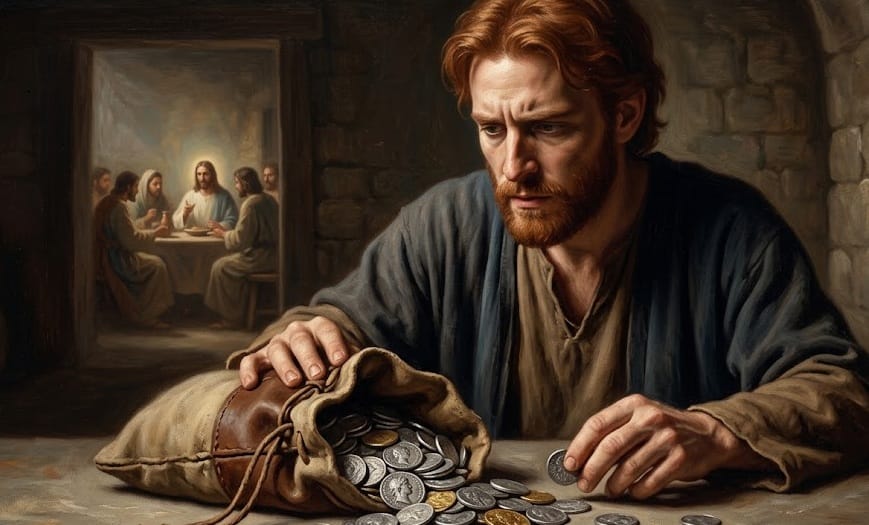
The one who would betray Jesus was entrusted with the money bag.
Scripture tells us plainly: “Judas was a thief, and having charge of the moneybag, he used to help himself to what was put into it” (John 12:6). Yet Jesus knew. He always knew.
This was not ignorance.This was intentional grace.
Jesus does not lead by controlling outcomes.
He leads by revealing hearts.
He does not remove temptation to create holiness. He allows testing to expose truth. The money bag was not the cause of Judas’ fall; it was the place where his secret love was slowly uncovered.
Judas walked beside incarnate Love
Day by day, he spent time with Jesus. He heard the Sermon on the Mount. He watched lepers cleansed, blind eyes opened, the dead raised.
He carried provision meant for the poor. Yet inside him, desire for more quietly grew.
How terrifying this truth is.
- You can live close to Jesus and still remain untouched by Him.
- You can handle sacred things while your heart is somewhere else.
- You can be trusted by God and still not be transformed by God.
Judas did ministry in the presence of Christ but never surrendered to the Lordship of Christ.
Jesus gave Judas responsibility not because Judas was faithful, but because love always gives space for repentance. Every coin Judas counted was another moment to choose contentment. Every offering he carried was another chance to fear God.
Every day with Jesus was mercy extending its hand again and again.
And still, Judas resisted grace.
What makes this story even heavier is not the betrayal itself, but the tenderness Jesus showed knowing it was coming.
Jesus washed Judas’ feet. The hands that would later exchange silver for blood were cleansed by the Savior. Jesus broke bread with him. Shared the Passover. Offered him friendship at the table.
“Friend,” Jesus would later call him, even in the garden.
This is the mystery of divine love: Jesus does not stop loving us when He sees our end. He keeps loving in hopes that we might turn.
Judas was not forced to betray Christ
He was given every opportunity not to. And this is where the story stops being about Judas and begins confronting us.
What has Jesus placed in your hands? Resources? Influence? Leadership? A calling? Are you stewarding it with reverence, or slowly letting it replace devotion?
The most dangerous temptation is not obvious rebellion.
It is quiet affection for something other than Jesus.
- A divided heart.
- A hidden compromise.
- A love that grows stronger while worship grows weaker.
Judas did not wake up one morning and decide to betray the Son of God. He drifted there, coin by coin, excuse by excuse, desire by desire, facade by facade.
And silver always seems small at first.
This story warns us: Proximity to holiness does not equal loyalty.
Spiritual activity does not guarantee spiritual surrender.
And being entrusted by Jesus does not mean our hearts are safe from idols.
May we tremble at this truth and run toward mercy. May we examine what we hold tightly. May we choose faithfulness in secret places. May we love Jesus not for what we can gain from Him, but for who He is.
Because betrayal rarely begins with a kiss, it begins when something else becomes more precious than Christ. Do you have something or someone right now that you have declared that you cannot live without?
Oh...may we never trade eternal glory for thirty pieces of silver that cannot heal a guilty soul.
 Greg Ogden




Member discussion