From Discipleship Class to Disciplemaking Movement
A certificate may recognize that a person completed the class, but it should never become the finish line. Graduation from a class should become an invitation to greater participation in Christ’s mission.

How Classes and MicroGroups Work Together to Make Disciples Who Make Disciples
You desire more than information about Jesus. You want a deeper, closer relationship with Him. You want His Word to shape how you think, how you live, and how you relate to others. You also want to obey His command to help others follow Him.
Then you hear two terms: discipleship class and MicroGroup.
Are they the same? Are they competing approaches? Is one better than the other?
A discipleship class and a MicroGroup are not identical, but they can work together beautifully. The class provides a structured doorway into what being a disciple means. The MicroGroup turns what is learned into a relational, reproducible way of life for making disciples who make disciples.
Together, they can create a clear pathway from class participant to disciplemaker, from disciplemaker to coach, and from coach to the development of a disciplemaking church.

Jesus gave us more than a classroom assignment
Before Jesus returned to the Father, He gave His followers this commission:
“All authority in heaven and on earth has been given to me. Go therefore and make disciples of all nations…teaching them to observe all that I have commanded you.”
—Matthew 28:18–20
Jesus did not merely command us to teach information. He told us to make disciples and to teach them to obey everything He commanded.
A person can learn a great deal in a class. But discipleship is not complete until truth moves from the page into daily life.
The destination is not simply knowing more about Jesus. It is becoming more like Jesus, helping others follow Jesus, and equipping those disciples to do the same.
That is where discipleship classes and MicroGroups can join hands.
What is a discipleship class?
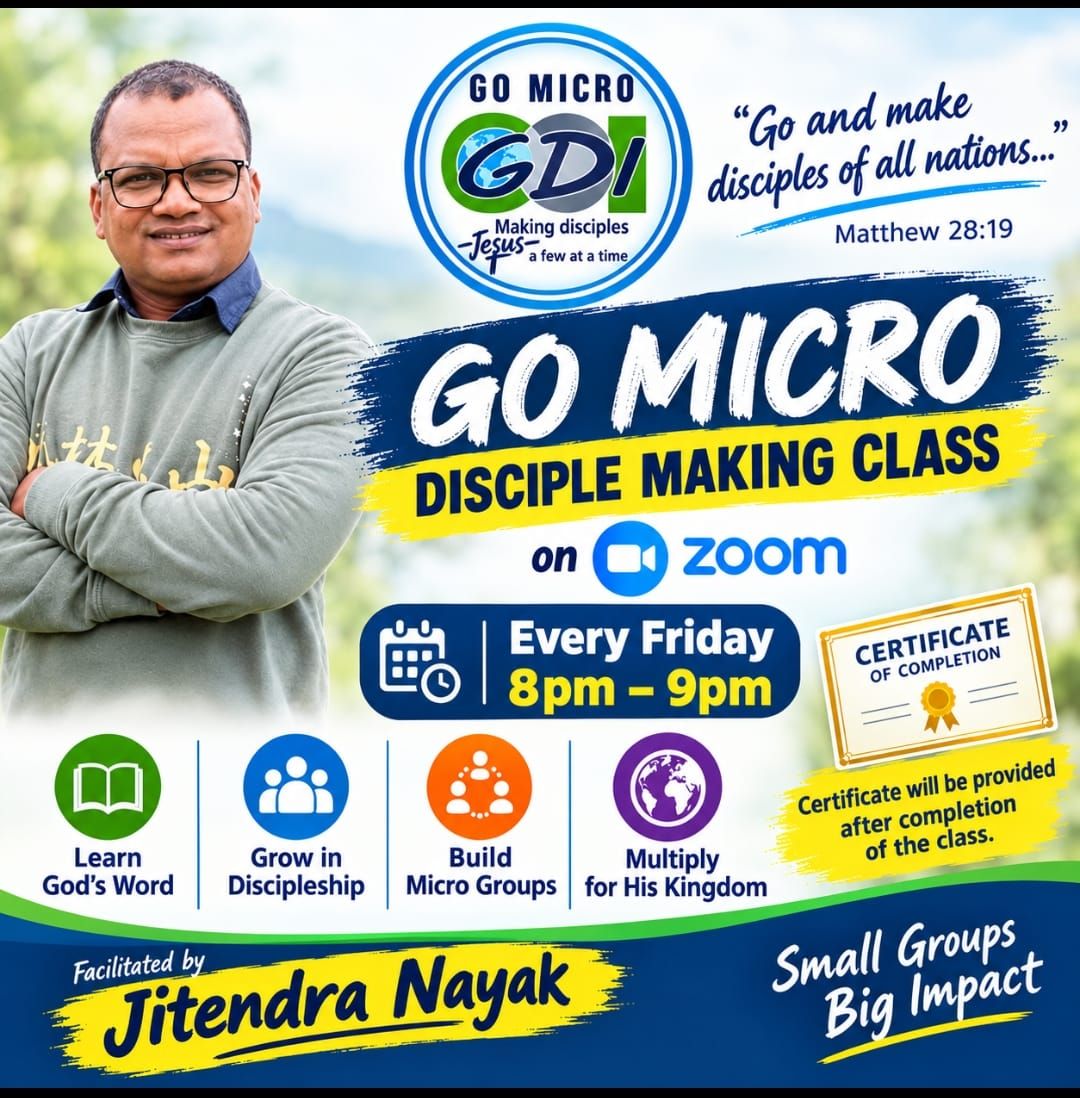
A discipleship class usually brings several people together for organized biblical instruction. It may meet in a church, training center, home, or online through Zoom.
A class can provide:
- A clear starting point
- A regular schedule
- Biblical teaching
- A trained facilitator
- A shared curriculum
- Opportunities for questions and discussion
- A certificate or other recognition of completion
- Exposure to the vision of making disciples
Participants are invited to:
- Learn God’s Word.
- Grow in discipleship.
- Build MicroGroups.
- Multiply for God’s Kingdom.
This progression is important. The class is not presented as an end in itself. It introduces people to a larger disciplemaking journey.
A certificate may recognize that a person completed the class, but it should never become the finish line. Graduation from a class should become an invitation to greater participation in Christ’s mission.
What is a MicroGroup?
A MicroGroup, sometimes called a quad, is normally composed of three or four people who meet regularly for intentional, relational discipleship. Using Greg Ogden’s Discipleship Essentials, participants study biblical truth, reflect on their lives, practice spiritual disciplines, encourage one another, and learn to make disciples.
The small size matters.
In a larger class, people can listen without being deeply known. They may attend faithfully while keeping their struggles, questions, and areas of disobedience hidden.
That is much harder to do in a circle of three or four.
A MicroGroup creates room for:
- Honest relationships
- Personal application of Scripture
- Prayer and mutual encouragement
- Accountability
- Spiritual transformation
- Discovery and use of spiritual gifts
- Practice leading discussions
- Preparation to begin another MicroGroup
The MicroGroup is not merely a smaller class. It is a spiritual training environment in which each person is being prepared to help others follow Jesus.
How are classes and MicroGroups the same?
Both formats can serve the same biblical purpose: helping people become mature followers of Jesus.
| Shared purpose | How it is expressed |
|---|---|
| Learning Scripture | Participants study and discuss God’s Word. |
| Growing spiritually | Biblical truth is connected to everyday life. |
| Building relationships | People learn alongside other believers. |
| Encouraging obedience | Participants are challenged to practice what Jesus taught. |
| Developing leaders | People discover that they can help others grow. |
| Advancing the Great Commission | Disciples are prepared to participate in making other disciples. |
Both formats need the Holy Spirit. Neither a well-taught class nor a well-organized MicroGroup can produce spiritual transformation through human effort alone.
We can prepare the soil, plant the seed, and water it faithfully, but only God gives the growth.
I planted the seed, Apollos watered it, but God has been making it grow. So neither the one who plants nor the one who waters is anything, but only God, who makes it grow." — 1 Corinthians 3:6-9
How Are They Different?
The greatest difference is not necessarily the material being studied. It is the relational environment and expected outcome.
| Discipleship class | MicroGroup |
|---|---|
| Can include many participants | Usually limited to three or four people |
| Often led by one primary teacher | Leadership and participation are increasingly shared |
| Emphasizes organized instruction | Emphasizes relationship, application, and accountability |
| May have a defined beginning and ending | Can become a repeatable disciplemaking lifestyle |
| Participants may primarily receive | Every participant is prepared to reproduce |
| Completion may be measured by attendance or coursework | Growth includes obedience, transformation, and multiplication |
| Introduces disciplemaking principles | Provides a setting in which disciplemaking is practiced |
A class can tell you how to use a compass. A MicroGroup walks beside you as you learn to follow the direction it gives.
We need both instruction and practice. We need truth explained and truth lived.
What is the bridge between the two?
Ralph Rittenhouse’s Leadership Development Pipeline shows how classes and MicroGroups can be connected intentionally.

The graphic presents a clear path:
Join Class → Start Quad → Complete Class → Class Coach → Reproduce Quads → Coach Quad Leaders → Model Church
This pathway prevents the class from becoming a spiritual cul-de-sac. Participants do not receive good teaching and then stop. Each stage prepares them for the next level of growth, responsibility, and multiplication.
Stage 1: Class Participant
The journey begins when a person joins a discipleship class. At this stage, the participant learns the biblical foundations of discipleship and begins to understand the Great Commission. The individual is not simply invited to complete lessons but to consider a new identity:
I am a disciple of Jesus who is learning to make disciples.
That expectation should be communicated from the beginning.
Stage 2: Quad Starter
The participant begins a MicroGroup, or quad, with a few other people.
Significantly, the pipeline places starting a quad before completing the class. This communicates an important principle: People do not need to become experts before they begin helping others follow Jesus.
They need humility, faithfulness, biblical guidance, and the willingness to take the next step. The class provides direction while the MicroGroup provides immediate practice.
Stage 3: Class Completion
As participants complete the class, they have done more than absorb information. Ideally, they have already begun applying what they learned in a relational disciplemaking setting.
Completion now means more than reaching the final lesson. It means becoming increasingly prepared to walk with others.
Stage 4: Class Coach
A mature participant may begin coaching other class members. The person’s role begins to shift from receiving to equipping. The coach encourages participants, answers questions, observes progress, and helps others take their first steps toward starting MicroGroups.
Coaching also provides an important layer of support. New leaders should not be sent out alone and expected to solve every problem by themselves.
Stage 5: Reproducer of Quads
Healthy MicroGroups are designed to multiply.
As participants mature, they start new groups and prepare others to lead. Multiplication does not mean dividing relationships carelessly. It means extending those relationships so that more people can experience intentional discipleship.
A fruitful MicroGroup carries spiritual seed within it. What God grows in one small circle can be planted in another.
Stage 6: Coach of Quad Leaders
As the number of groups increases, experienced leaders begin coaching other MicroGroup leaders.
This develops leadership at several levels:
- Disciples are growing.
- New disciplemakers are leading.
- Experienced leaders are coaching.
- Coaches are preparing additional coaches.
This reflects Paul’s instruction to Timothy:
“And what you have heard from me in the presence of many witnesses entrust to faithful men, who will be able to teach others also.”
—2 Timothy 2:2
Paul taught Timothy. Timothy was to entrust the truth to faithful people. Those people were to teach others.
Four generations of spiritual multiplication are visible in one verse.
Stage 7: Model Church and National Leadership
As the culture of multiplication grows, an entire church can become a model of relational, intentional disciplemaking.
A model church does more than host a discipleship program. Disciplemaking becomes part of its spiritual DNA.
Its leaders do not ask only, “How many people attended?”
They also ask:
- Are people becoming more like Jesus?
- Are they obeying what He taught?
- Are disciples learning to make disciples?
- Are MicroGroups reproducing?
- Are new leaders being developed?
- Are coaches supporting those leaders?
- Is the church helping other churches develop the same culture?
From healthy model churches, national leaders can emerge. These leaders understand the vision, practice the process, coach others, and adapt the strategy appropriately within their own cultural setting.
The movement remains locally rooted while advancing globally.
How Can the two formats be combined?
A strong combined model might follow this pattern:
- Use the class as the invitation.
Invite people into a clear, accessible discipleship class. Explain that the purpose is not merely to earn a certificate but to begin a disciplemaking journey. - Introduce the MicroGroup vision immediately.
From the first session, help every participant understand that discipleship is relational and reproducible. Do not wait until the final lesson to mention multiplication. - Form MicroGroups during the class.
Arrange participants into groups of three or four. Encourage them to begin meeting while the class is still underway. The class teaches the principles. The MicroGroup becomes the practice field. - Use Discipleship Essentials as a common foundation.
A shared resource gives groups biblical structure while still allowing honest conversation, personal application, prayer, and accountability. The curriculum serves the relationship. The relationship should not become secondary to finishing the curriculum. - Give every new leader a coach.
New MicroGroup leaders need encouragement, prayer, correction, and practical help. Coaching keeps leaders connected and strengthens faithfulness. - Expect multiplication without forcing it.
Multiplication should be part of the group’s vision from the beginning, but it should grow from spiritual health rather than pressure. We are not trying to reproduce meetings. We are asking God to reproduce mature disciples. - Develop churches, not only isolated groups.
MicroGroups should strengthen the local church. As groups multiply and leaders mature, the whole congregation can develop a disciplemaking culture. The goal is not to build a separate ministry beside the church. It is to help the church become increasingly faithful to Jesus’ disciplemaking mission.
A pipeline is only helpful if people keep moving.
A pipeline can show direction, but it cannot create spiritual life. Movement through these stages must never become a search for titles, positions, or recognition. In God’s Kingdom, leadership is stewardship. We move forward so that we can serve others more faithfully.
At every stage, we must return to Jesus.
- The class participant follows Jesus.
- The quad starter depends on Jesus.
- The coach points people to Jesus.
- The MicroGroup leader models obedience to Jesus.
- The model church reflects the character and mission of Jesus.
- The national leader equips others to make Jesus known.
Jesus remains the source, center, and destination of the entire pathway.
Jesus often ministered to crowds, but He invested deeply in a few. He called twelve disciples and developed an even closer relationship with three. Through a relatively small group of ordinary people, the gospel began spreading to the nations.
The same principle continues today.
One class can introduce many people to disciplemaking. Those participants can begin MicroGroups. MicroGroups can reproduce. Leaders can coach new leaders. Churches can become models. National leaders can equip churches throughout their countries.
What begins with a few people gathered around God’s Word can become a multiplying movement.
What is your next step?
You do not have to see the entire journey before taking the next faithful step.
Is your next step is to join a discipleship class?
Is it to move beyond attending and begin a MicroGroup?
Is God calling you to coach a new leader, help reproduce groups, or guide your church toward a disciplemaking culture?
The Great Commission was not given only to pastors, missionaries, or highly trained leaders but was entrusted to ALL followers of Jesus.
You may begin as a participant, but you are not called to remain only a participant. Jesus is shaping you into a disciple who can walk beside others.
Learn God’s Word.
Grow as a disciple.
Build MicroGroups.
Develop leaders.
Multiply for God’s Kingdom.
The pathway begins with a simple invitation from Jesus:
Follow Me.
And as you follow Him, He prepares you to invite others to follow Him too.
 Greg Ogden