Invite, Equip, Coach: Preparing Today for Tomorrow’s Multiplication
Who am I inviting? Who am I equipping? Who am I coaching to help someone else grow?

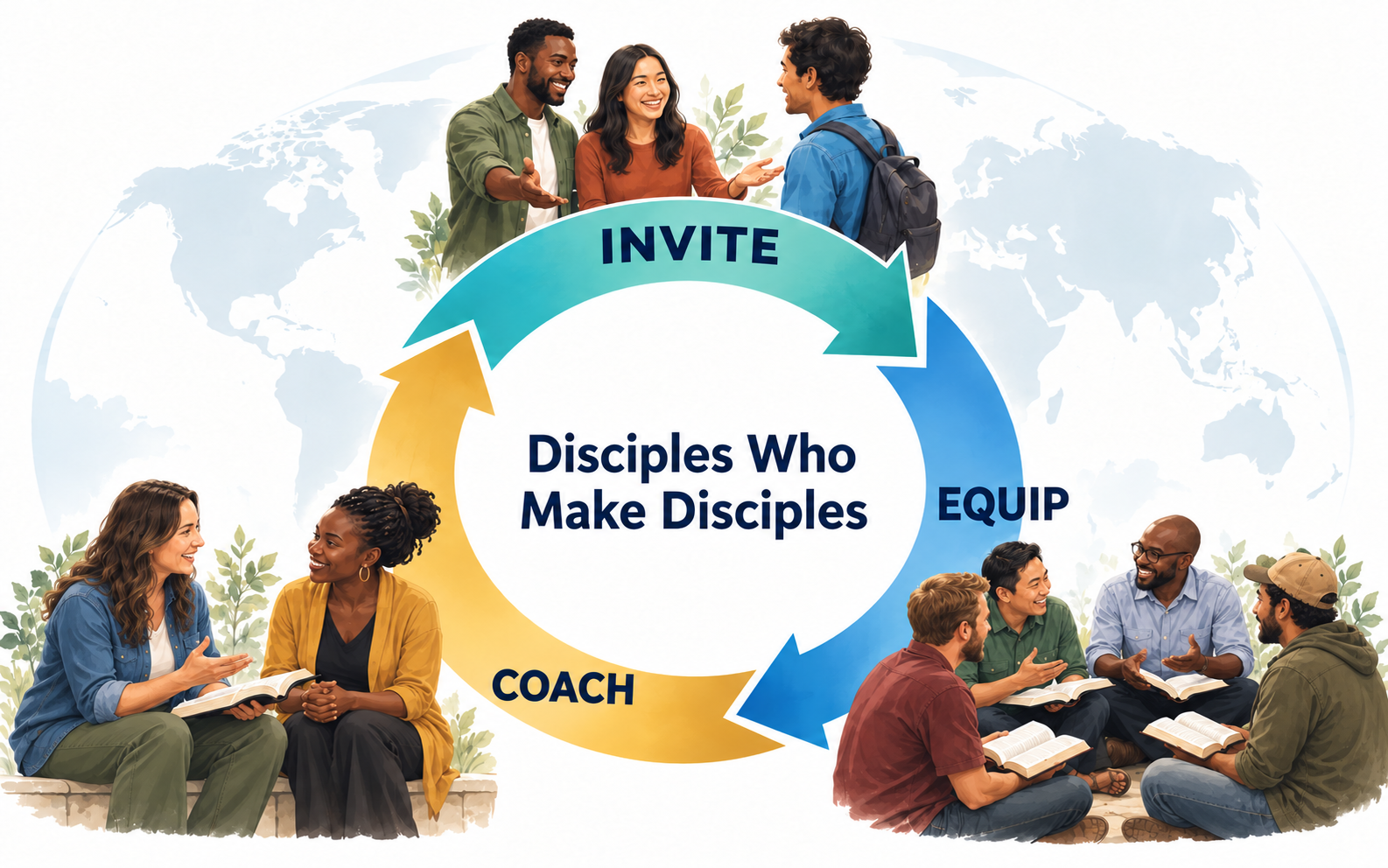
A circle of arrows can tell a powerful story: Invite. Equip. Coach, and continue inviting. Each movement leads into the next, and each return to the circle opens the door for more people to participate.
For Global Discipleship Initiative (GDI), these three initiatives give us a shared focus for ministry around the world. They also raise a question we need to address now: How well are these priorities taking root in the lives of people and the leadership of local ministries?
A clear graphic helps us communicate our direction. Prayerful evaluation helps us discover whether we are actually moving in that direction.
A Shared Focus—and a Shared Responsibility
Historically, individual countries and continents largely worked out their own approaches to advancing the ministry. Local initiative has helped leaders respond to their communities, cultures, and opportunities. Now, for the first time in our ministry’s history, we have a coordinated focus across the ministry: Invite, Equip, and Coach overarching a 7-step process to build coaching MicroGroups for greater support.
More recently, we have brought these priorities into our goals, plans, and budgeting. This connects what we say matters with the resources we commit to it. Our calendars, spending, and leadership attention should help these three efforts become a lived reality.
With this greater clarity comes a greater responsibility. We need to evaluate early, learn together, and anticipate what growing ministries will need. Waiting until difficulties become deeply rooted makes them harder to address.
Like a gardener tending a young vine, we can observe where growth is healthy, where support is needed, and where something is restricting fruitfulness. Jesus reminds us that fruit comes through abiding in Him (John 15:4–5). Our planning must remain rooted in that dependence.
The Circle Keeps Moving
Inviting opens the door. We invite people into a deeper relationship with Jesus and into the shared life of a MicroGroup, where three or four people can grow together.
Equipping prepares them to live as disciples and disciplemakers. Through Scripture, honest relationships, prayer, and practical obedience, participants learn to put Jesus’ teaching into practice.
Coaching provides ongoing encouragement, guidance, and accountability as people begin helping others grow. Coaching helps emerging leaders address challenges, develop confidence, and equip others in turn. Coaching has a lot to do with asking good questions, going deeper.
These movements overlap. A person receiving coaching may continue inviting others. An experienced leader still needs equipping. As new disciplemakers invite, equip, and coach others, the circle extends into another generation.
Four areas now call for our shared attention.
1. Helping Multiplication Become a Lifelong Conviction
We speak about multiplication to the fourth generation. We need to gather and examine how that actually happens—and what we may be doing that gets in its way.
In 2 Timothy 2:2, Paul describes a pattern of entrusting teaching to faithful people who can teach others. That pattern gives us a practical picture of truth and responsibility passing from one generation to the next.
The decisive issue reaches into the heart: Does a MicroGroup participant begin to believe, “Jesus has called me to make disciples, and I will live this calling for the rest of my life”?
That conviction develops as people experience Christ’s love, obey His Word, see disciplemaking modeled, and receive opportunities to practice it with support. Completing material is one step.
Embracing a lifelong calling requires continuing formation.
All of us need growth here. The Great Commission belongs to all of us, not only leaders (Matthew 28:18–20). We must allow the same calling we communicate to others to shape our own lives.
A searching question can guide our conversations: What change, if it took root, would fundamentally transform our ministry?
Helping people internalize their identity and calling as disciplemakers belongs near the center of our answer. Our shared gathering can help us explore what nurtures that conviction, what weakens it, and how our practices encourage people to pass on what they have received.
2. Growing Strong Leadership in Local Hubs
Decentralization places meaningful responsibility closer to the people and communities being served. Local leaders bring knowledge of language, culture, relationships, and needs that distant leadership cannot fully possess.
As this develops, we need to share what we are learning. Where is local responsibility strengthening ministry? Where do leaders need clearer authority, better support, or additional preparation?
Our leadership development process should contribute directly to growing teams at the heart of each local hub. A ministry becomes more resilient when several people can carry responsibility, develop others, and remain united around a shared mission.
This requires deliberate preparation. Emerging leaders need opportunities to serve, make decisions, receive feedback, and gradually carry greater responsibility.
Local ownership and mutual accountability can grow together. Shared commitments help us move in the same direction while allowing faithful expression in different settings.
3. Equipping Teams for the Work Ahead
Every new stage of ministry reveals skills we need to develop. Leading a MicroGroup, coordinating a regional ministry, and building a leadership team each bring different responsibilities.
Teams need to learn how to clarify roles, make decisions, communicate across differences, address conflict, and support one another. These skills help people serve together with maturity and trust.
Provide team building training.
Ephesians 4:11–16 connects equipping God’s people with the growth of the whole body. Developing teams is part of preparing people to contribute to that shared growth.
As we identify needs, our goals and budgets should make room for the training and coaching that help leaders meet them. Recognizing a need becomes fruitful when we take practical steps to address it.
4. Imagining Leadership for an International Ministry
As local hubs develop, we must also consider the international leadership needed to support them.
A ministry serving across continents needs leadership that hears and learns from those continents. One possibility to explore is an international council with continental representation, moving us beyond a primarily U.S.-centered leadership model.
Such a council could bring valuable perspectives into shared discernment and help strengthen relationships across the ministry. Leaders in different regions have lessons to offer one another about faithfulness, perseverance, cultural understanding, and multiplication.
This is a direction for discernment. We still need to consider responsibilities, representation, decision-making, accountability, and the steps required to develop such a structure.
We do not need every answer before beginning that conversation. We do need a shared picture of the future we hope to serve. Prayerful imagination can help us identify practical next steps before growth overtakes our capacity to support it.
Evaluate Early, Learn Together, Keep Multiplying
Invite, Equip, and Coach give us a common direction. Regular evaluation can help us keep that direction connected to everyday ministry.
We can listen to participants and leaders, examine whether new generations of MicroGroups are forming, identify barriers, and connect what we learn to future goals, training, coaching, and budgets. Numbers can reveal patterns; people’s stories help us understand what those patterns mean.
Evaluation also gives us opportunities to celebrate God’s work. A participant who begins a new MicroGroup, a leader who learns to share responsibility, or a team that grows through a difficult season can encourage the whole ministry.
As you consider your own ministry, ask: Who am I inviting? Who am I equipping? Who am I coaching to help someone else grow?
The circle continues through people who depend on Jesus and pass on what they have received. As we prepare leaders, strengthen teams, and learn together, we make room for that calling to take root across generations and around the world.